Is your phone system keeping up?
Business growth, distributed teams and changing customer expectations can expose the limits of a legacy phone system.
Here are nine practical signs that your organization has outgrown traditional phone lines — and what to evaluate before moving to SIP.
~8 min read • Business Communications Guide

Your telecom infrastructure should grow with the business.
New locations, remote working and international customers create different calling requirements. Reviewing the architecture, capacity and provider arrangements helps determine whether the existing infrastructure remains appropriate.
If rising costs, limited capacity, international calling or multi-location complexity sound familiar, SIP Trunking deserves a closer look.
First: What is SIP Trunking?
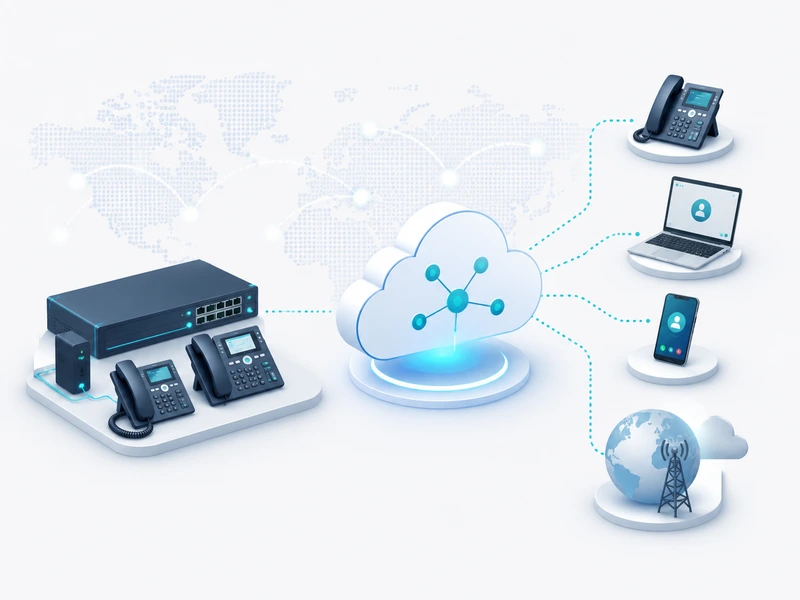
SIP stands for Session Initiation Protocol. In practical terms, SIP Trunking lets a business carry voice calls over an IP network instead of relying entirely on traditional physical telephone lines such as PRI.
A SIP trunk can connect a compatible PBX or IP-PBX to the public telephone network through an internet connection.
That gives businesses a path to modernize voice infrastructure without necessarily replacing every phone, extension or workflow at once.
- Keep compatible PBX infrastructure
- Scale call capacity more flexibly
- Support multiple offices and countries
Why businesses move to SIP
The strongest business case is usually a combination of cost control, flexibility, resilience and easier expansion.
Lower telecom friction
Reduce dependence on legacy circuits and simplify how business voice is delivered.
Scale on demand
Add capacity for new users, teams, offices or campaigns without thinking only in physical lines.
Build globally
Combine SIP, virtual numbers and cloud communications to support international operations.
Your Phone Bill Keeps Growing
A growing phone bill is one of the clearest reasons businesses investigate SIP Trunking. Traditional infrastructure may involve physical circuits, capacity charges, maintenance and separate services at different locations.
This becomes especially noticeable for organizations with multiple offices, large numbers of extensions, high call volumes or international customers.
Better question: “What is our total communication cost per employee, location and call today?”
iVoice note: Cost is not only the monthly trunk fee — calculate total cost across circuits, providers, locations and call traffic.
Adding Phone Capacity Has Become Complicated
Imagine your sales team suddenly hires 20 people. Can your telephone system accommodate them quickly?
SIP Trunking can make capacity more flexible. Instead of thinking primarily in physical lines, businesses can provision communication capacity around actual demand — useful for rapid hiring, seasonal peaks, campaigns and geographic expansion.
You Operate More Than One Office
Multi-location businesses often accumulate fragmented systems: one provider here, another PBX there, different numbers elsewhere.
SIP Trunking can help standardize voice connectivity across locations so branches become part of one broader communications architecture instead of separate telecom islands.
Your Employees No Longer Work From One Building
The traditional office phone system assumed employees were sitting beside their desk phones. Modern teams work from headquarters, branch offices, home, customer sites and other countries.
SIP and cloud communications can provide a better foundation for distributed teams while retaining professional business calling capabilities.
International Calling Is Important to Your Business
International operations expose the limitations of traditional telephony quickly. Customers prefer familiar numbers, sales teams want local presence, and support teams need reliable inbound and outbound calling.
SIP-based communications combined with international virtual numbers can help a business create a broader communications footprint without recreating a full telecom setup in every market.
iVoice note: Global expansion works best when numbering, routing, regulatory coverage and support are planned together.
Your Existing PBX Works — But Your Phone Lines Are Outdated
Modernization does not always require throwing everything away. If a compatible PBX still serves your users well, SIP may provide a migration path that upgrades external connectivity while preserving useful internal infrastructure.
That can make modernization more strategic and less disruptive than a full rip-and-replace project.
You Need Better Business Continuity
What happens to incoming calls if your office becomes temporarily unavailable because of an outage, equipment failure or local disruption?
IP-based communications offer more options for designing redundancy and call-routing strategies. Depending on the architecture, calls can be redirected toward alternative offices, numbers or destinations.
iVoice note: SIP does not automatically create resilience; failover and redundancy must be designed into the solution.
Your Communications Tools Don’t Work Together
Business communications now include CRM platforms, Microsoft Teams, contact centers, help desks, recording, analytics and AI-enabled applications.
Modern SIP and cloud communications can provide a stronger foundation for integrating voice with the wider technology stack.
Your Telecom Setup Is Too Difficult to Explain
Ask someone responsible for telecom: “Can you explain our entire phone setup in five minutes?”
If the answer involves several providers, obsolete contracts, undocumented forwarding rules and equipment nobody wants to touch, you may have telecom technical debt. Complexity affects troubleshooting, security, expansion and budgeting.
SIP is not only about cheaper calls.
For modern businesses, the bigger opportunity is flexibility: scaling capacity, connecting locations, supporting remote teams, reaching customers globally and integrating voice into the company’s digital infrastructure.

Before switching, ask these 7 questions
Do not select a SIP service only by the lowest advertised price. Business voice is operational infrastructure — reliability, routing, coverage, support, scalability and security all matter.
1. Is my existing PBX compatible with SIP?
2. How many simultaneous calls does the business actually require?
3. Which countries do we frequently call?
4. Do we require local or international virtual numbers?
5. What redundancy or failover options do we require?
6. What security controls are available?
7. Can the solution scale with our expected growth?
A simple global-business example
Headquarters: Singapore
Sales team: India
Customers: United States, United Kingdom and Europe
Support staff: Distributed across several locations
SIP Trunking + Virtual Numbers + Cloud Communications + Intelligent Routing
A unified architecture can be easier to manage than separate telecommunications arrangements for every market and office.
Is SIP Trunking right for your business?
If several of these nine signs sound familiar, review your current infrastructure before making a purchasing decision.
- What you currently have
- What it currently costs
- Where it limits your business
- What the business should look like in the next 12–36 months
Design communications around where your company is going — not where it used to be.
Build a smarter communications foundation with iVoice.
Whether you are evaluating SIP Trunking, business VoIP, virtual numbers or a broader cloud communications strategy, iVoice can help you identify the right architecture for your current infrastructure and future growth.